
Everything you need to know about the care of aloe vera plants indoors
The Beginner’s Secret to Keeping Aloe Vera Alive and Thriving Indoors
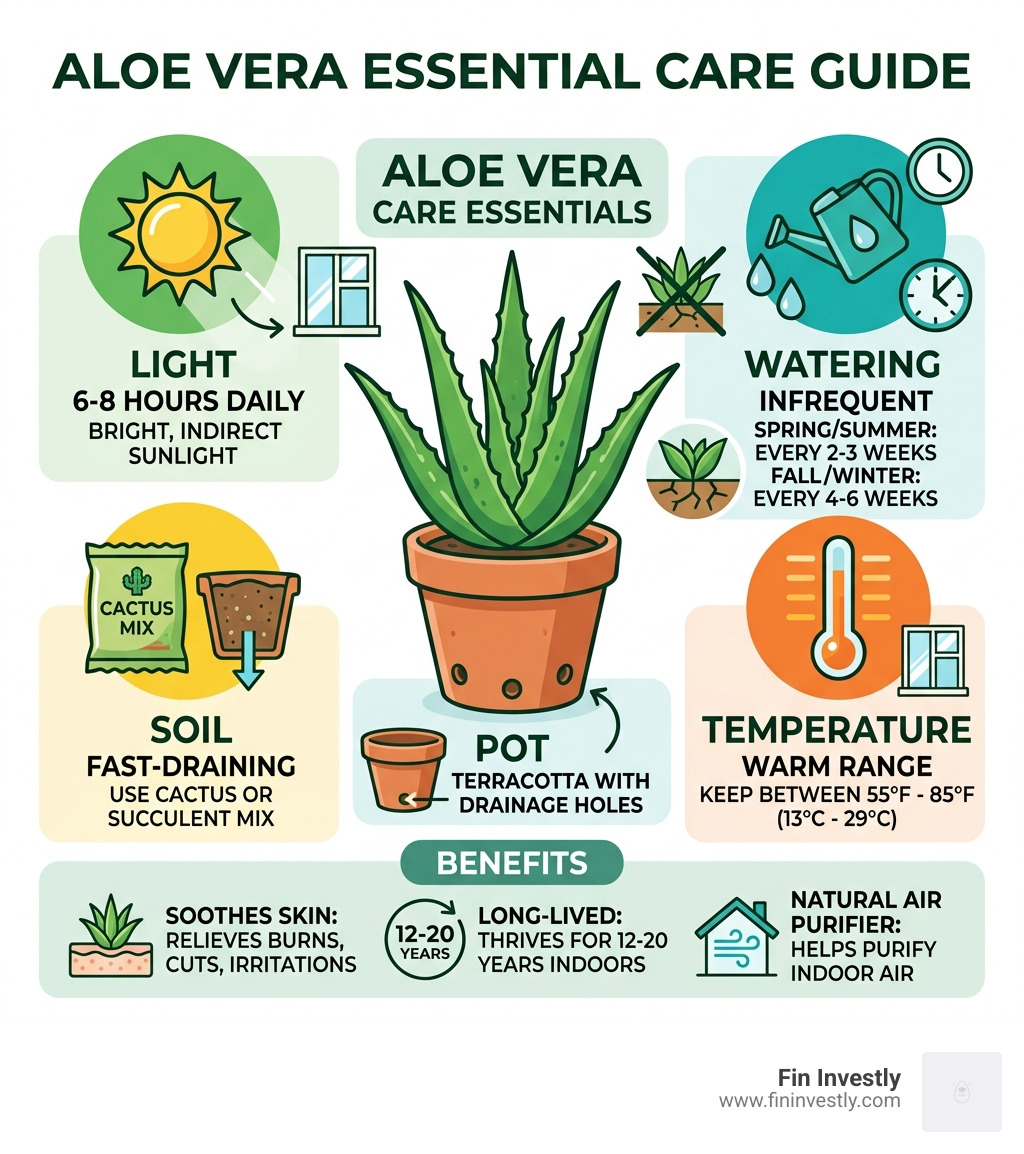
At Fin Investly, we know that the best results come from smart, sustainable growth—whether you’re building a financial portfolio or a home garden. The care of aloe vera plants indoors comes down to a few simple rules: bright indirect light, infrequent watering, fast-draining soil, and warm temperatures. Get those right, and this plant practically takes care of itself.
Quick answer — what indoor aloe vera needs:
| Care Factor | What To Do |
|---|---|
| Light | 6-8 hours of bright, indirect sunlight daily |
| Watering | Every 2-3 weeks in spring/summer; every 4-6 weeks in fall/winter |
| Soil | Well-draining cactus or succulent mix |
| Temperature | Keep between 55°F and 85°F (13°C to 29°C) |
| Pot | Terracotta with drainage holes |
| Fertilizer | Once a year in spring, diluted to half-strength |
| Repotting | Every 2-5 years, or when root-bound |
Aloe vera (Aloe barbadensis miller) is one of the most forgiving houseplants you can own. It’s native to arid regions of Africa and the Arabian Peninsula, which means it’s built to survive neglect — but not overwatering. Much like a high-yield investment, it thrives when you provide the right foundation and then let it grow without constant interference.
Most people who lose their aloe plant make one mistake: they water it too much. As one common observation among plant growers goes, the number one killer of aloe vera is too much water, not too little. In financial terms, think of overwatering as over-leveraging; it puts too much stress on the system.
The good news? Once you understand how this plant thinks — storing water in its thick leaves, going dormant in winter, thriving in poor soil — everything else clicks into place.
Aloe also earns its spot indoors beyond just looking good. Its gel has been used for centuries to soothe burns, cuts, and skin irritations. Some research even supports its use for first- and second-degree burns. And with a lifespan of up to 12-20 years indoors with proper care, it’s a long-term companion worth getting right.
This guide walks you through everything: light, water, soil, pruning, propagation, pests, and more.
Essential Light and Temperature Requirements
When we talk about the care of aloe vera plants indoors, light is the currency the plant uses to grow. Just as an investor monitors market conditions, a plant owner must monitor the “energy intake” of their greenery. Since these plants are native to sun-drenched environments like the Arabian Peninsula and parts of Africa, they have a high demand for brightness. However, there is a nuance to indoor lighting that many beginners miss.
In our homes, we should aim to provide at least 6 to 8 hours of bright, indirect sunlight daily. The ideal placement is usually near a south-facing or west-facing window. These spots offer the intensity the plant craves without the localized heat that can occur in some climates.
Temperature-wise, aloe vera is quite comfortable in the same range humans prefer. They thrive in temperatures between 55°F and 85°F (13°C to 29°C). If you are comfortable in your t-shirt, your aloe is likely happy, too. However, we must be careful during the transition into winter. Aloe vera is incredibly frost-sensitive. If temperatures drop below 50°F (10°C), the plant can suffer cellular damage, and a hard frost will almost certainly be fatal. If you keep your plants on a windowsill, ensure the leaves aren’t touching the cold glass during those April 2026 chilly nights.
For those of us living in apartments or homes with limited natural light, don’t worry—you can still master the care of aloe vera plants indoors. Modern LED grow lights are a fantastic solution. We recommend a 10-20 watt full-spectrum LED grow light placed about 6 to 12 inches above the plant for 10-12 hours a day. This mimics the sun’s energy and prevents the plant from becoming “leggy.”
For more detailed insights on balancing indoor and outdoor environments, you can check out A Guide on How to Grow and Care for Aloe Vera Indoors and Outside.
Light requirements for the care of aloe vera plants indoors
There is a fascinating phenomenon we call the “Sunburn Paradox.” Aloe vera is the world’s most famous remedy for sunburned skin, yet the plant itself can get sunburned! This usually happens when a plant that has been in a dim corner is suddenly moved into intense, direct afternoon sun.
Signs of too much light:
- Reddish or brownish leaves: This is the plant’s way of “tanning” to protect itself from UV rays.
- Dry, scorched spots: If the sun is too intense, the leaves will literally cook, leaving permanent scars.
Signs of too little light:
- Etiolation: This is a fancy botanical term for “stretching.” The plant becomes tall, thin, and weak as it searches for a light source.
- Drooping leaves: Instead of standing up in a proud rosette, the leaves will flop over to increase their surface area for light absorption.
- Pale color: Healthy aloe should have a vibrant green or slightly bluish-green tinge. If it turns a pale, sickly yellow-green, it’s likely starving for photons.
To ensure even growth, we recommend rotating your pot a quarter-turn every few weeks. This prevents the plant from leaning toward the window and keeps that iconic symmetrical shape.

Mastering the care of aloe vera plants indoors: Watering and Soil
If light is the currency, water is the investment strategy. In care of aloe vera plants indoors, “less is more” is the golden rule. Because aloe is a succulent, it stores massive amounts of water in its fleshy leaves. It is designed to survive long droughts, not floods. Think of this as maintaining a cash reserve; you want enough to survive the dry spells, but too much idle liquidity (or water) leads to rot.
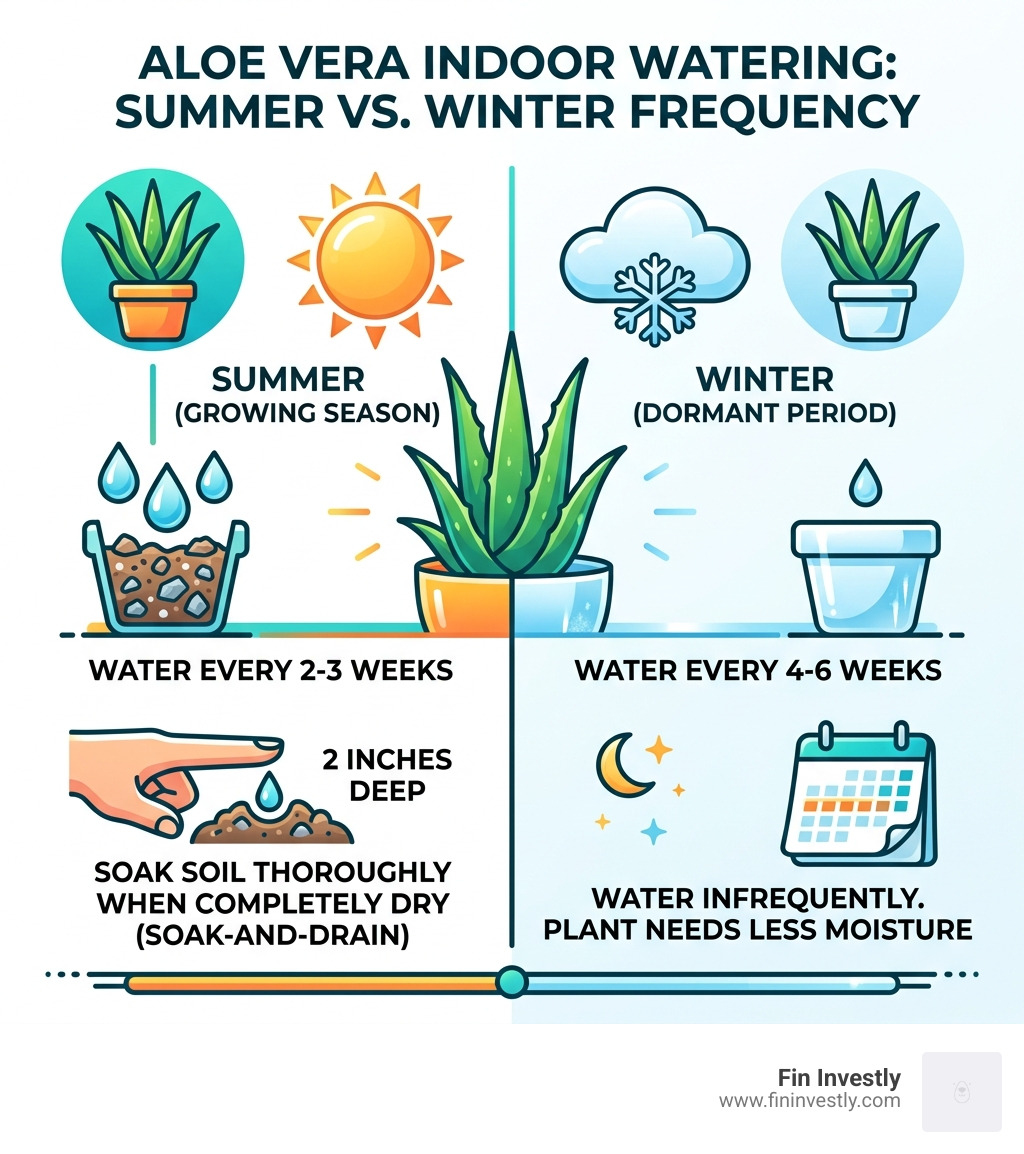
The most effective way to water is the “soak-and-drain” method. This involves watering the plant deeply until water flows out of the drainage holes at the bottom of the pot, then waiting until the soil is completely dry before watering again.
How do you know when it’s dry? Use the “finger test.” Stick your finger about 2 inches into the soil. If you feel even a hint of moisture, walk away. In the growing season (spring and summer), this usually means watering every 2-3 weeks. In the winter, when the plant goes dormant, you might only water once every 4-6 weeks.
Soil and potting for the care of aloe vera plants indoors
The soil you choose is the foundation of your plant’s health. Regular potting soil is often a death sentence for aloe because it retains too much moisture. We need a “lean” mix that allows water to pass through quickly. At Fin Investly, we believe a solid foundation is key to any growth strategy, and for aloe, that means drainage.
The Ideal Soil Recipe: If you want to mix your own, aim for:
- 50% regular potting soil
- 25% perlite or pumice (for aeration)
- 25% coarse sand or lava rock (for drainage)
Alternatively, any commercial “Cactus and Succulent Mix” will work perfectly.
When it comes to the pot, material matters. Terracotta is the gold standard for the care of aloe vera plants indoors. Because terracotta is porous, it allows moisture to evaporate through the walls of the pot, helping the soil dry out faster. Whatever pot you choose, it must have drainage holes.
The Gravel Myth: You might have heard that putting a layer of gravel at the bottom of a pot without holes helps drainage. This is actually a myth! It creates a “perched water table,” which keeps the roots sitting in a pool of water at the bottom of the soil. Always use a pot with a hole, and skip the gravel layer.
Aloe vera actually enjoys being slightly root-bound. When the roots feel a bit snug, the plant is more likely to produce “pups”—small baby plants that sprout from the base. When you do repot, choose a pot that is wider rather than deeper. Aloe has a shallow, spreading root system, so a wide “azalea-style” pot is better than a tall, narrow one.
Maintenance: Pruning, Fertilizing, and Repotting
Once your aloe is established, maintenance is minimal but essential. Pruning isn’t just about aesthetics; it’s about plant hygiene and ensuring your “green capital” isn’t wasted on dying leaves. Over time, the bottom-most leaves (the oldest ones) will naturally shrivel or turn brown. This is normal.
To prune, use a pair of clean, sterilized garden shears. Cut the dead or damaged leaf as close to the main stem as possible. Never cut a leaf in half unless you are harvesting the gel, as the blunt end will remain and can become an entry point for disease. If you notice brown tips, it could be a sign of low humidity or chemical sensitivity to tap water. You can trim just the brown tip off, but many growers prefer to leave them or remove the whole leaf for a cleaner look.

Fertilizing is another area where we must be careful. Aloe vera is a “light feeder.” In its natural habitat, it grows in nutrient-poor soil. We recommend fertilizing only once a year, in the spring, at the start of the growing season. Use a balanced, water-soluble fertilizer (like a 10-10-10 or a 10-40-10) diluted to half-strength. Over-fertilizing can lead to a buildup of salts in the soil, which can burn the roots—much like how over-trading can erode your investment returns.
Repotting is generally needed every 2 to 5 years. You’ll know it’s time when:
- The plant becomes “top-heavy” and keeps tipping over.
- Roots are growing out of the drainage hole.
- The plant is so crowded with pups that you can no longer see the soil.
When repotting, inspect the roots. Healthy roots should be firm and tan or orange-ish. If they are black and mushy, you have root rot, and you’ll need to trim those parts away and let the plant dry out for a day before replanting in fresh, dry soil.
For a deep dive into propagation and long-term maintenance, see this Aloe Vera Plant Care Guide: How to Grow, Water & Propagate.
Propagation and Troubleshooting Common Problems
One of the most rewarding parts of the care of aloe vera plants indoors is that the plant eventually gives you “free” plants. These are called offsets, or more affectionately, “pups.” In finance, we call this compounding interest—your initial investment generating new assets over time.
To propagate pups:
- Wait until the pup is about one-third the size of the mother plant (usually 3-4 inches tall).
- Remove the entire plant from the pot.
- Gently pull or cut the pup away from the mother, ensuring the pup has some of its own roots attached.
- The Callousing Step: This is vital. Let the pup sit out in the air for 1-3 days. This allows the “wound” where it was attached to dry and form a callous, which prevents rot when you plant it.
- Plant the pup in a small pot with succulent mix and wait a week before watering.
Note: While you can technically propagate some succulents from a single leaf, this rarely works with aloe vera. The leaves usually rot before they can grow roots. Stick to pups for a 99% success rate!
Troubleshooting the care of aloe vera plants indoors
Even the best plant parents run into trouble. Here is how to read your plant’s distress signals and protect your green assets:
The Mushy Base: If the base of your aloe turns brown and feels squishy, this is the dreaded root rot. It’s caused by overwatering. If caught early, you can save the plant by removing it from the soil, cutting away the rot, letting it dry for a few days, and repotting in bone-dry soil.
Wrinkled, Thin Leaves: This is the opposite problem—underwatering. If the leaves look deflated or have deep “valleys” in them, the plant has used up its water reserves. Give it a good soak, and it should plump back up within a few days.
Pest Patrol:
- Mealybugs: These look like tiny bits of white cotton hiding in the crevices of the leaves.
- Scale: These look like small, hard brown bumps on the leaves.
- Treatment: We find that dabbing the pests with a cotton swab dipped in 70% isopropyl alcohol is the most effective way to kill them on contact. For larger infestations, neem oil or insecticidal soap works wonders. Always isolate an infested plant so the bugs don’t spread to your other green friends!
Frequently Asked Questions about Aloe Vera Care
Will my indoor aloe vera plant flower?
In the wild or in warm climates (Zones 9-12), aloe vera produces stunning tall spikes of yellow or orange tubular flowers. Indoors, however, it is quite rare. To even have a chance, the plant must be mature (at least 4-5 years old) and receive a massive amount of light—more than most windows can provide. Some growers find that a “cool rest” in the winter (keeping the plant around 55°F) can help trigger blooms in the spring, but don’t be discouraged if yours stays strictly foliage.
How do I safely harvest aloe vera gel?
To use the gel for a burn or skin mask, always pick an outer, mature leaf. Use a clean, sharp knife to cut the leaf at the base. Important: Stand the leaf upright in a glass for 10-15 minutes. You will see a yellow liquid (called aloin or latex) drain out. This liquid is a potent laxative and can irritate the skin, so you want to discard it. Once drained, wash the leaf, slice off the serrated edges, and fillet the leaf to reveal the clear, soothing gel inside.
Is aloe vera toxic to humans or pets?
Yes, caution is required. While the clear inner gel is used topically, the plant should not be ingested in large quantities. According to the ASPCA, aloe vera is toxic to dogs, cats, and horses. The saponins and anthraquinones in the plant can cause vomiting, diarrhea, and lethargy if eaten. Always keep your aloe on a high shelf or in a room where your curious pets can’t reach it.
Conclusion
Mastering the care of aloe vera plants indoors is a journey that rewards you with a beautiful, functional, and resilient companion. By mimicking its natural desert home—plenty of light, well-draining soil, and a “tough love” approach to watering—you can ensure your plant thrives for a decade or more. It is the ultimate “slow and steady” plant, much like a well-managed investment.
At Fin Investly, we believe in the power of smart, long-term strategies. Whether you are cultivating a lush indoor garden or building a robust financial portfolio, the principles are the same: start with a solid foundation, provide the right environment for growth, and don’t over-manage the process. Our investment services are designed to help you grow your wealth with the same efficiency and resilience shown by a healthy aloe vera plant.
Ready to see your assets grow as steadily as your greenery? Start growing your wealth today with Fin Investly and let us help you implement smart investing strategies for fast, sustainable growth. Happy gardening, and happy investing!
